
Our brief flirtation with electric cars
During our frequent trips to Queretaro we’ve noticed an increased number of Chinese car dealerships, many offering electric models. Forget the familiar Chevy, Ford and Toyota names and tune your ear to exotic brands that sound like a dim sum buffet: Geely, Jac, BYD, Omoda, Danfeng, Saic, Baoyun and GWM (“Great Wall Motors”), and which are also showing up on the roads and parking lots of the city, though I haven’t spotted any in San Miguel.
Just in the past two years, Chinese cars have crashed into the Mexican auto market full-speed. Last year alone sales of Chinese cars in Mexico went up 63 percent, largely driven by their low price, sometimes $6,000 to $10,000 cheaper than comparable Japanese, European or American models but also their distinct style and apparently first-class craftsmanship. However, European countries, the U.S., and under American pressure, also Mexico, have responded with protective tariffs because many of the Chinese car makers are owned and subsidized by the government, which puts domestic private car manufacturers elsewhere at a disadvantage.
The buzz about electric cars caught up with Stew and I when we noticed a BYD (“Build Your Dream”) dealership right next to the Audi agency in Queretaro where our Q5 was being serviced. Chinese-anything is a tough sell to Stew who late in life has developed an acute case of sinophobia and says he doesn’t want to buy anything Chinese-made. Such one-man boycotts, I have explained, amount to a hiding under a rock when soon enough even rocks will come from China.
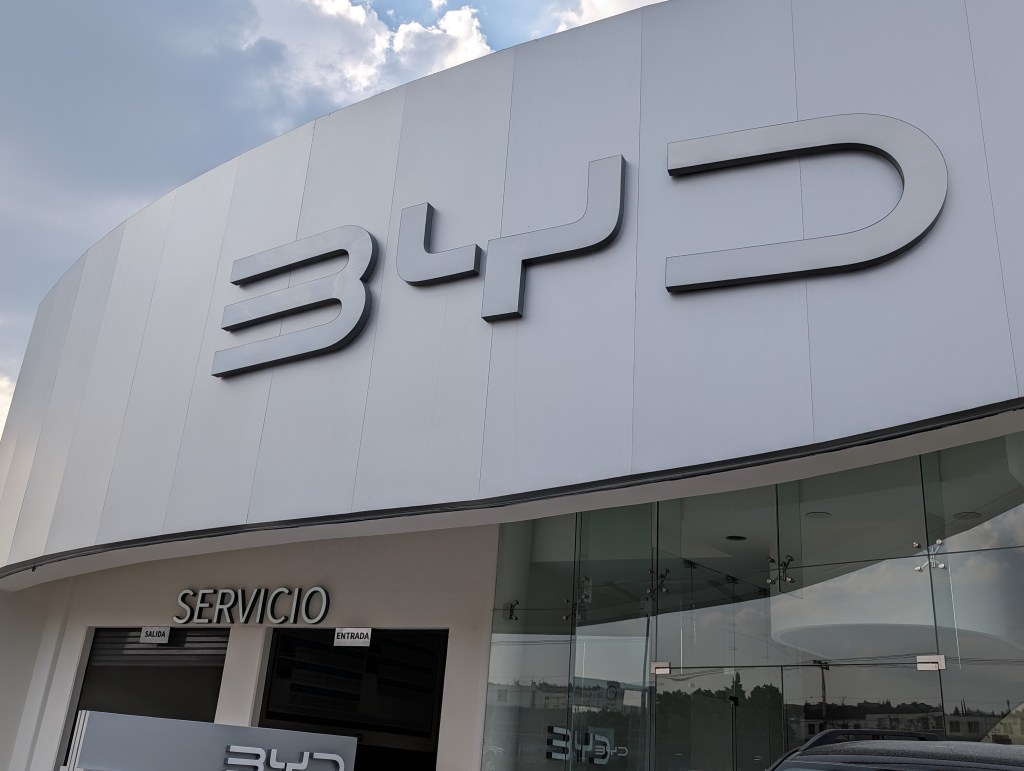
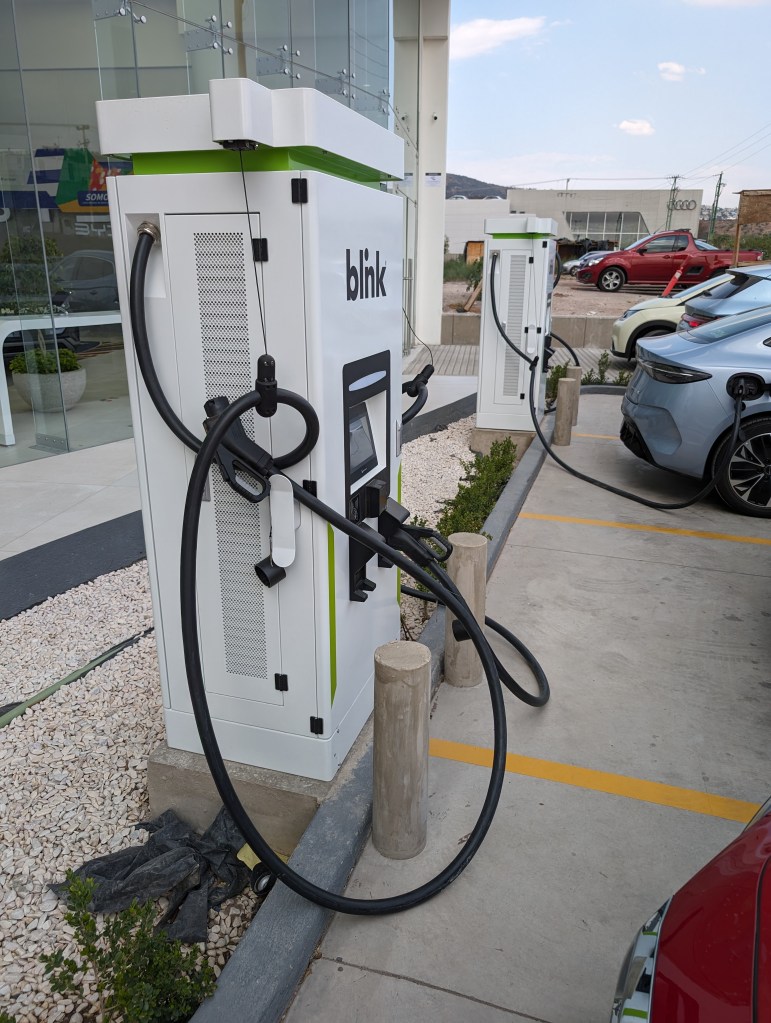
Curiosity overcame his prejudices, though, and we walked over to the BYD dealer where we were greeted by a curvy young woman who took our email address, offered some water and passed us on to an eager salesman. The sales floor, behind floor-to-ceiling glass windows, gleamed under an array of electric spotlights that highlighted the shiny vehicles, most of them electric but one a hybrid plug-in, which is a combination electric and a small conventional engine. Outside the showroom there were two electric vehicle charging stations that resembled the familiar pumps at a gas station.
Our preconceived notions, fed by memories of junky Japanese and Korean cars that once appeared in the U.S., were that Chinese cars would be equally unappetizing. Instead the BYDs we saw and sat in seemed absolutely first-class in every respect, even with the new-car aroma, and not at all cheap knock-offs of American or Japanese cousins. Their interior design had a distinctive retro look that may strike some buyers as a bit weird. It shouldn’t surprise that Chinese car manufactures can produce high-quality cars because for years they have been making American- and European-branded cars.
In fact, globalization has turned the car market into a jambalaya of components made in different parts to the world. Our Audi Q5 is assembled in Puebla, next to a mammoth Volkswagen plant that has operated for years, with most components made in Germany but some in Hungary. Cars and pickups sold in Mexico can have engines or transmissions made in Brazil or Argentina, or perhaps Thailand, regardless of their putative brand of origin.
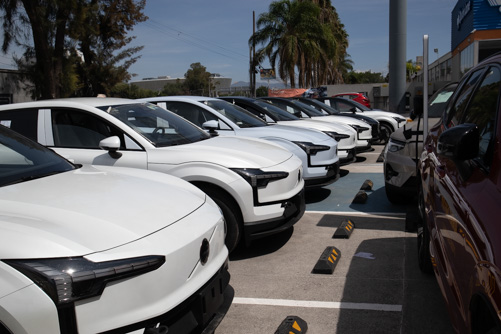
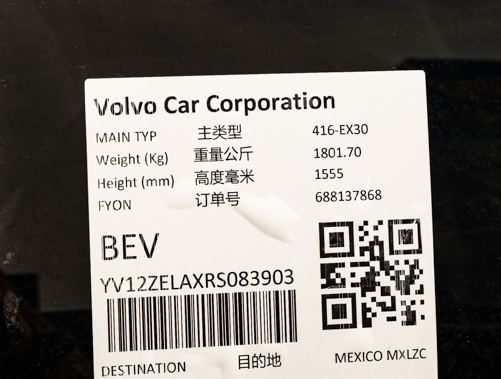
After checking out the BYD electrics, a huge billboard lured us to visit the Volvo dealership nearby where electric vehicles of varying sizes and design dominated the showroom. Stew’s sinophobia went off again like a gong when we discovered that the Volvo EX-30, the smallest and best-selling model, damn, is made in China. On our second visit to the Volvo dealer there were dozens of EX-30s on the parking lot and more being offloaded from a truck.
So we checked out the larger models, made in Belgium and Sweden. Volvos’ tank-like feel and obsession with safety live on: The salesman took us out for a ride in a medium-size model and demonstrated a range of startling safety features—video monitors on all four sides of the car, automatic sensors that slowed the car if it was too close to the one ahead and a corrective mechanism that detected the stripes on the pavement and nudged the car back into the lane if it was drifting off, presumably because of driver fatigue or exhaustion.
But the car we drove also has two adrenaline-pumping electric motors that propelled it at rocket speed in seconds. If during his famous televised chase in 1994 O.J. Simpson had been driving one of these Volvos instead of his pokey white Ford Bronco, he would have gotten to Vancouver before the Los Angeles cops reached Oregon.
Problem is that the batteries in the Volvo, or any electric vehicle marketed today, wouldn’t have taken O.J. that far. The Volvo we tested claimed a 300-mile range but that is a nominal estimate under certain driving conditions, certainly not a high-speed chase. Besides, recharging the batteries can take up to six or eight hours, unless you find a turbo charger, still rare in Mexico, that would put you back on the road in a half-hour with an eighty percent battery charge.
Undeterred, we figured even that limited range would work fine for us, if we installed a home charger that would slowly “fill up” the Volvo overnight. Our newly updated solar electric plant could handle the job and we would effectively operate the Volvo for nothing, if we used it for our usual runs to town or nearby Querétaro. Besides, maintenance on a electric vehicle is comparatively negligible because it doesn’t have pistons, valves and other moving parts that come with an internal combustion engine.
But those savings come at a relatively stiff sticker price for the Volvo we tested which was, gulp, $75,000 dollars, though the Mexican government offers a discount on the annual plate-renewal fees, and also waives the air pollution inspections.
But what if we wanted to drive to Monterrey, or even the U.S.? We could make pit-stops to recharge the car, but that assumes the availability of turbo chargers. Google maps now indicate the location of charging stations, but in places like Saltillo, Matehuala or San Luis Potosi we found only a few. In San Miguel there is a new turbo charger by the Soriana grocery store, and elsewhere in the Luciérnaga shopping center and the Live Aqua Hotel, but the last two are Tesla chargers whose connectors are incompatible with those in other brands.

Soon, the thrills of a zippy electric vehicle deflated by a new phenomenon in mental health: “recharge anxiety.”
No doubt that in a few years electric chargers will become as common as gas pumps did when internal combustion vehicles were introduced, and I can imagine chargers showing up at conventional gas stations and highway rest stops. In Amsterdam, for instance, several years ago we saw electric vehicle chargers alongside parking meters, and in Paris many city buses were électrique.
But in Mexico, where it took several years before hybrid Toyota Priuses appeared after they were common in the U.S., it will take even longer to develop a wide and reliable network of chargers.
So for now, that hissing you hear is the sound of the air going out of the tires of Stew and Al’s electric car dreams.
 El Rancho Santa Clara
My condo doesn’t have any electrical charging stations yet but I assume they will be here soon.
Sent from my iPhone
LikeLike
Then what? Are you going to get a second mortgage and buy a Tesla?
LikeLike
Nope I would not buy one even if I won the lottery.
Sent from my iPhone
LikeLike
Hello friend,
I love the look of the Tesla sedan, I see quite a few of them in our area up here in the PNW, but I worry about the same charging dilemma, it is hard enough for me to remember to stop for gas when I need to, I would be the gal with the cool Tesla waiting for the tow truck because I forgot to charge.
LikeLike
We’ve ridden in a couple Tesla taxi cabs and the interior of the basic model is rather bleak, but when you move up, they get pretty slick. And the only problem is not only the number of charging stations, but time that it takes to charge a car, unless you find a “turbo” charger and there aren’t many of those around right now. Thanks for your comment.
LikeLiked by 1 person
Great article! I now understand much more about electric cars.
LikeLike
Well, I glad I enlightened someone! Actually the business with the lack of fast recharging stations is the deal breaker for most people buying an electric car, though every day you hear about improvements, breakthroughs, etc. But it will be three or four years I figure before they widely available, particularly in a place like Mexico. Thanks for your comment.
LikeLike
Thank goodness . Was that $75,000 usd? If so, oy vey
LikeLike
Barb: Care prices have shot up to the sky while your were napping, though I agree that $75,000 US is a bit steep.
LikeLiked by 1 person
I don’t think the technology is ready yet. It is still wild west type hype-I’m going to wait a decade before I buy an electric car.
LikeLiked by 1 person
I’m not a sinophobe, but ideally China would make cars for China and Mexico would make cars for Mexico, etc. as much as practical. As John Maynard Keynes said, let things like art, science, tourism, and technology be international, but let goods be homespun whenever possible.
LikeLike
I’m tempted by the thought of buying an electric car. I’m definitely persuadable. What I want for a car is to get from A to B as comfortably, quietly and cheaply as possible. I can’t wait for self driving vehicles to become the norm.
The UK govt wants us all to drive electric cars. Alas, most of us live in flats, and the red tape and costs mean it’s hard to get chargers installed. We could charge up at external points, but if they are actually working and don’t actually have a car in the bay already, then it costs more than petrol. In fact, it might be cheaper to fill up on champagne.
Then there’s the cost of the cars. And the cost of insurance, which is also inflated for electric vehicles. Once I’ve ruled out all the unaffordable options, I’m left with the MG 4. The most British or marques. Which is, of course, owned by a Chinese firm. And built in China. And like Creigh, I’m not a Sinophobe. But aside from Keynesian economic philosophy, I can see which way the wind is blowing, which gives cause for a pause regards electric cars from China.
My current car will be with me another 18 months. I suspect my next will still have a combustion engine. I am rather tempted by the Mazda MX30, which is an electric car. But with its reinvention of the Wankel rotary engine to provide the juice.
On topic, and you might enjoy:
The Clarkson review: Volkswagen Golf GTI — still king of the hot hatchbacks
https://www.thetimes.co.uk/article/jeremy-clarkson-car-review-volkswagen-golf-gti-38cwknzgr
LikeLike