A cluck-cluck here and a cluck-cluck there
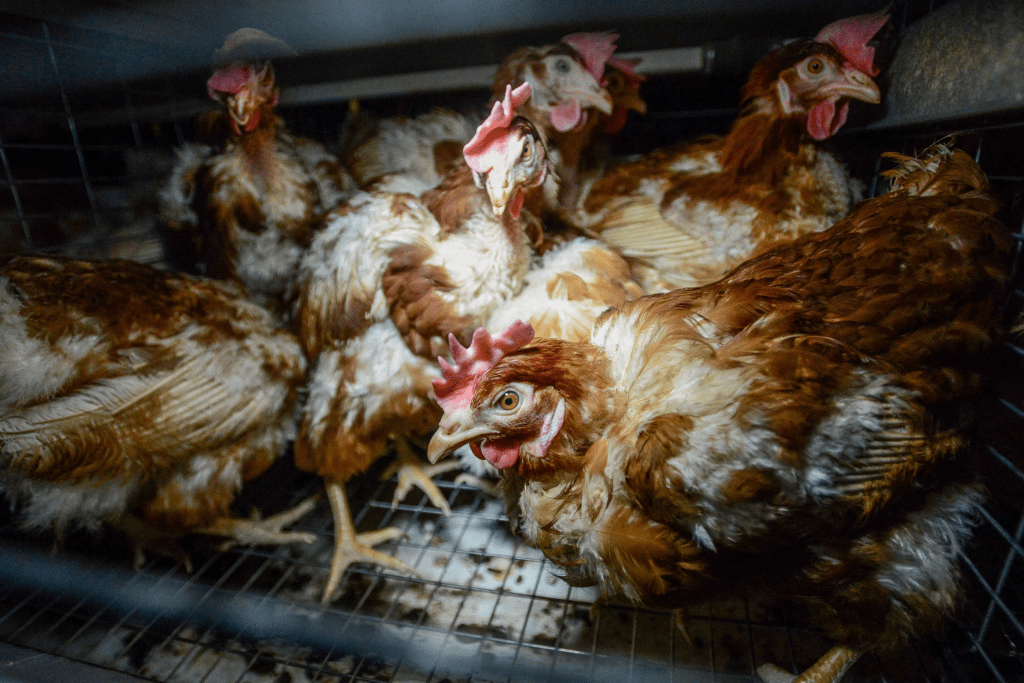
Several years ago, Stew and I came upon a traffic accident we didn’t quickly forget. A semi-truck filled with what must have been hundreds, maybe thousands, of chickens caged in wire compartments had just overturned and its load had turned into a bloody pile of dead and wounded birds scattered on the pavement, feathers still floating in the air, a few survivors scampering in all directions. It was yet another reminder of the brief and miserable lives of chickens and other animals in factory farms where they are treated like non-sentient food objects destined to spend their lives accordingly.
As lifelong animal lovers, Stew and I feel a jolt of guilt at scenes like this, and mumble about embracing a vegetarian diet, at least occasionally, like Roman Catholics used to forgo meat on Fridays. Indeed, as cynical carnivores would point out, how can you bemoan the tragic lives of chickens and other animals raised in factory farms and then have one of them for dinner? Alas, our noble vegetarian impulses never transcend the aspirational. Stew does the cooking and though he can come with some terrific dishes his culinary efforts are mostly propelled by hunger rather than the joy of spending hours in the kitchen fine-tuning the perfect paella. He’ll also remind me that since I don’t much care for most greens to begin with, there’s no point for him to prepare a broccoli and cauliflower casserole, or some other vegetarian exotica, when most of it will end up in a Tupperware container in the back of the refrigerator before going in the trash.
One way we try to quell our concerns about chickens and other animal sources of protein like beef or pork, is to donate to organizations that promote more humane treatment of farm animals even if ultimately they end up on the menu anyway. The Humane League is one such group, which seeks to eradicate the use of “battery cages,” a system used by so-called factory farms to keep hens confined in wire cages, much like those in the semi that we saw overturned. Such stiflingly limited space prevents the birds from flapping their wings, jumping, scratching the soil looking for worms, or other basic instinctual behavior, except to lay eggs machine-like. Campaigns by the Human League and other groups claim success in persuading large grocery stores and some fast-food vendors to adopt “free-range” methods of raising chickens, though the definition of “free range” can get fuzzy. We look for such labels when we buy chicken or eggs.
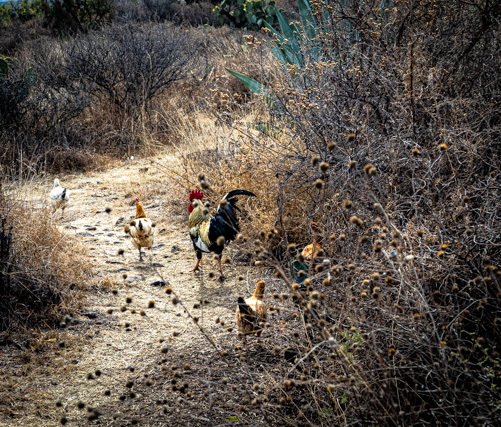
A couple of weeks ago we took more direct action, albeit symbolic, to allay our guilt toward chickendom by adopting four hens and a rooster that now merrily roam cluck-clucking around the seven-and-a-half acres of our ranch, though they seem to prefer to circle the house. They may occasionally bump into one of our four dogs or two cats but everyone seems to get along or at least ignore each other. In some cases we’ve spotted the rooster in the garage.
At night we escort them all to a large netted greenhouse we had built and later abandoned to protect vegetables from the voracious grasshoppers that invade the ranch during the summer. There our chickens have plastic vegetable crates Félix converted to roosting compartments, plus food and water, and are protected from foxes, possums and other potential nighttime predators. In the morning our feathered quintet noisily gathers by the door, flapping their wings, cluck-cluck-cluck, and dart out at rocket speed for another day of roaming around the ranch. At night either Félix or I chase the rooster back to the coop, and the four hens hustle behind, single-file. They pay attention more readily to Félix, maybe because they recognize him.
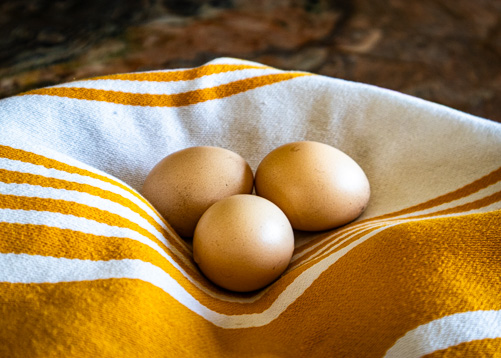
I’ve been amazed how quickly this bunch has learned not only the morning and late-afternoon routines, but also how the hens keep changing the place where they hide the eggs, which lately are coming at the rate of three or four daily. At first they laid the eggs by a plastic statue of St. Francis in the middle of a flower bed, and Félix would collect the eggs except one, to encourage the hens to lay more on the same spot. Except the hens caught on to Félix’s tricks and moved their roosting area fifty feet across the yard, under a tarp covering a pile of firewood. I expect this hide-and-seek game to continue. One thing I learned from these guys and our late hen, Henrietta, who showed up dead one morning for no apparent reason, is that while chickens may not be up to learning algebra, they are far from the addled, bird-brained creatures humans make them out to be. Aside from routines, they seem to recognize people—Félix versus me—and solve survival problems, like relocating their eggs to keep them from being stolen. Félix and I also hope our chicken troupe will control grasshoppers—their favorite meal—a summertime plague, that attacks practically all vegetation.
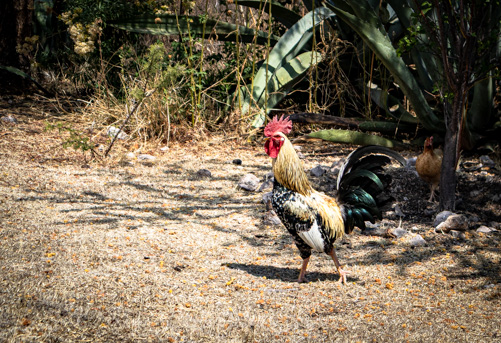
I’ve refrained from naming the hens, which are pretty much undistinguishable from one another, and risking them becoming pets. But the rooster, a large and regal, colorfully plumed specimen, I’ve named Fernando. Several times a day he jumps on a rock and crows several times to let the hens—and us—know he’s king of this small jungle.
Thinking ahead, of course, Stew had to ask Félix what we will do when the hens quit laying. “Chicken soup,” he replied without hesitation. That brought memories of my Cuban childhood, when my grandmother and aunt in Cuba prepared arroz con pollo, which involved buying a “fresh” chicken—meaning live—which one of them would dispatch with a quick twist of the neck, and pluck in a bathtub of hot water.
I don’t want to be around for a reenactment here of that family tradition.
###
 El Rancho Santa Clara
I grew up eating animals that we raised from babies, did not like the killing part one bit, did like the eating. Our chickens had a shed that had automatic water and feed, most of them stayed there or in the area. It was in a pine woods that provided lots of natural food for their needs, the area was not so safe from predators, many were eaten by beasts of the wood-we did not get many old chickens…
LikeLike
You and I have the same problem: We don’t like the killing but love steaks or pork chops. As for elderly chickens, we don’t know yet. We have foxes and possums around and if we leave the chickens out at night, predators would be more than happy to take of the surplus.
al
LikeLike
delightful post!
LikeLike